
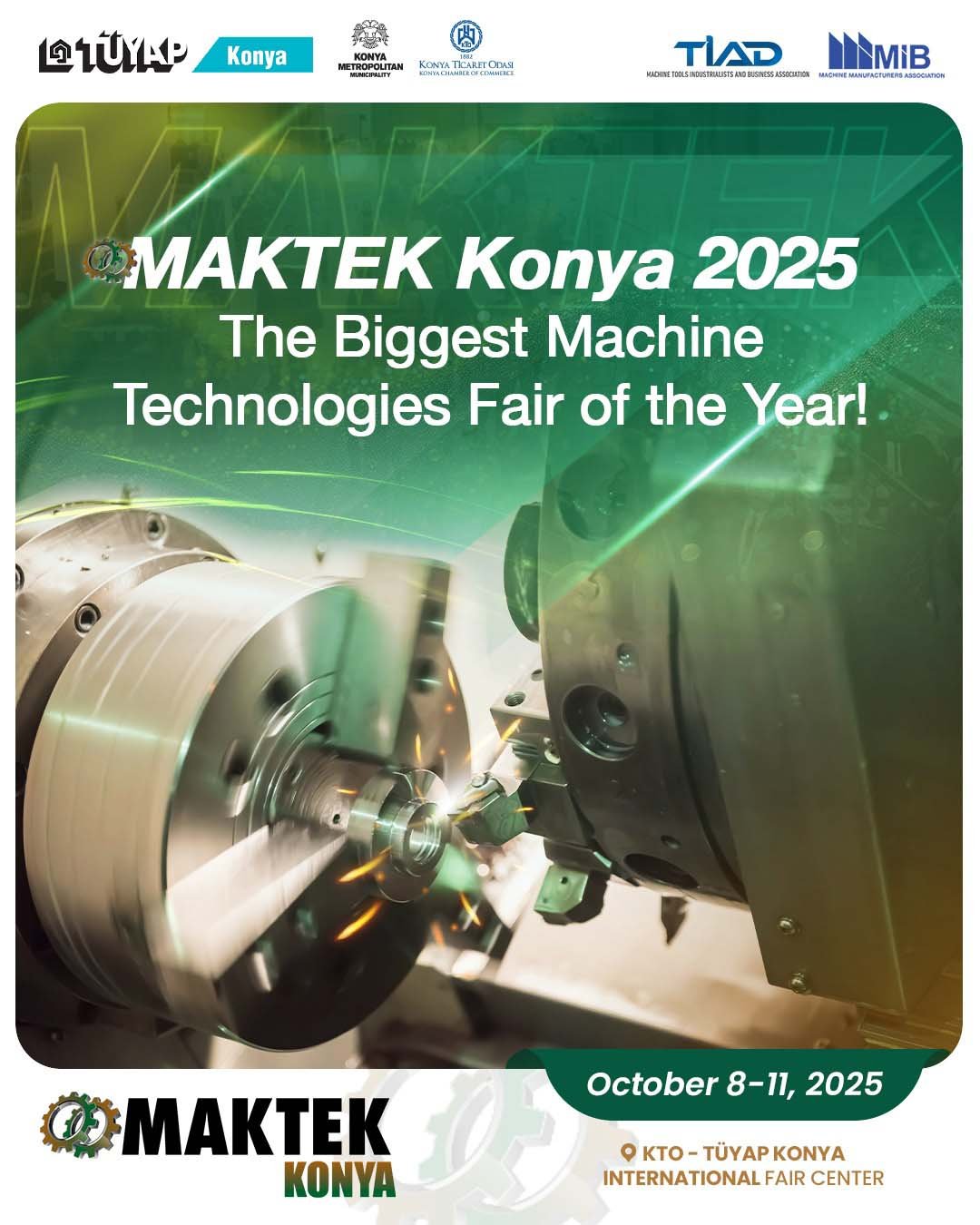
MAKTEK Konya: The Epicenter of Technology and Investment Potential
MAKTEK Konya serves as a pivotal assembly point for the machinery manufacturing sector and is actively engaged in preparations to unite the industry under a single venue in Konya, recognized as the production hub of Anatolia. As the largest machinery exhibition of the year, this event will showcase the latest technologies and the most reputable brands within the industry, contributing to an increase in trade volume for this year.
The 3rd Edition of MAKTEK Konya – Machine Tools, Metal-Sheet Metal Processing Machines, Tool Holders, Cutting Tools, Quality Control – Measurement Systems, CAD/CAM, PLM Software, and Manufacturing Technologies Fair – is scheduled to take place from October 8 to 11, 2025, at the Konya Chamber of Commerce – Tüyap Konya International Fair Center. This event will be organized by the Tüyap Fair Organization Group in collaboration with the Machine Tools Industrialists and Business People Association (TIAD) and the Machine Manufacturers Association (MIB).
A pivotal assembly point in Konya, the epicenter of technology
The upcoming exhibition is set to take place over a sizeable area of 45,000 square meters, allocated across four halls. This event is anticipated to attract over 20,000 participants from both local and international backgrounds. Notably, this year, InnoPark Konya Technology Development Zone, a key player in the innovation and entrepreneurship ecosystem of Konya, will also participate in the exhibition.
A pivotal assembly point for international trade
MAKTEK Konya is poised to serve not only as a focal point for Türkiye but also as a hub for numerous international attendees from various countries. This year, substantial participation is anticipated, particularly from representatives from countries including Algeria, Morocco, Tunisia, Egypt, Romania, Iraq, Germany, Kazakhstan, Saudi Arabia, Italy, and France.
While the initiatives aimed at attracting international visitors continue to gain momentum, bolstered by the robust foreign office network of Tüyap, specialized procurement committee programs will be organized to facilitate direct business interactions between purchasers and sector representatives from the targeted markets and exhibitors. Consequently, Maktek KONYA is set to evolve into a significant business platform, where not only product exhibitions will take place but also new commercial partnerships will be established.
A dynamic platform for the sector
MAKTEK Konya 2025 will showcase a comprehensive selection of products that highlight a diverse range of machining and metal forming machines, including CNC machining, sheet-metal processing, and saw machines, cutting and holding tools, CAD/CAM, and PLM software. The exhibition will also feature welding machines, electric-electronic and automation systems, gears, sub-industry equipment, compressed air technologies, and logistics solutions.
Green Transformation Summit and Exhibitor Panels
The upcoming exhibition will feature a noteworthy initiative entitled the “Green Transformation Summit”. This summit will provide an opportunity for leading companies in the industry to share their insights and perspectives on sustainability and green manufacturing practices. Key topics for discussion will include energy efficiency, digitalization, strategies for reducing carbon footprints, and the principle of a circular economy.
The “Exhibitors Talking” sessions, to be conducted at the summit, will introduce a novel dimension to MAKTEK Konya. This specialized program will facilitate the exchange of best practices and innovative solutions in green transformation among participating companies and industry professionals, aiming to foster information sharing and pave the way for new collaborative opportunities.
As the largest machinery exhibition of the year, MAKTEK Konya serves as an essential forum for industry professionals to explore the latest technological advancements within the sector, foster new business relationships, and closely examine the emerging manufacturing trends of the future.
The exhibition will be accessible to visitors from 10:00 AM to 7:00 PM from October 8 to 10, and from 10:00 AM to 06:00 PM on October 11.
About TÜYAP: Tüyap was established by Bülent Ünal in 1979 as the first fair organization company in Türkiye. Since its inception, the Tüyap Fair Organization Group has successfully hosted numerous domestic and international fairs over a span of 45 years, positioning itself as a leader in the development of fair organizations within Türkiye. Throughout these events, Tüyap has facilitated the participation of over 350,000 firms from various countries and has welcomed more than 70 million visitors. The company organizes specialized fairs and operates international offices in six countries, in addition to owning and managing three exhibition centers within Turkey. Tüyap collaborates with over 100 trade associations, leveraging its team of professionals to enhance the quality and effectiveness of its events. Moreover, Tüyap conducts export product fairs in China, Russia, and Africa, and consistently organizes Turkish participation in an average of ten international fairs each year. Notably, Tüyap is the only privately owned fair organization in Turkey with a dedicated fair center. Furthermore, the Tüyap Fair Organization Group continues to innovate by organizing hybrid fairs utilizing digital platforms.
Follow Tüyap Fair Organization Group on social media accounts:
Instagram: @tuyapfuarcilik
LinkedIn: /tuyapfuarcilik
Ucimu: orders index in the third quarter of 2026 rise (+10.5%) foreign orders (+24.7%); domestic ord
In the third quarter of 2026, the machine tool orders index compiled by the UCIMU-SISTEMI PER PRODURRE Study & Business Culture Centre recorded a 10.5% increase compared to the July-September 2025 period . In absolute value, the index stood at 58.9 (base 100 in 2021). In particular, orders collected across borders grew by +24.7% compared to the third quarter of 2025, for an absolute value of 108.6. Order intake in Italy, however, decreased by 7.1% compared to the same period of the previous year. The absolute value of the index stood at 14.3. Riccardo Rosa , President of UCIMU-SISTEMI PER PRODURRE, stated: " Domestic demand remains weak despite the numerous ongoing negotiations. The uncertainty of the international context and the increase in energy costs are clearly impacting the activity of Italian manufacturing operators, who are postponing investments pending greater clarity. We are therefore confident ," added President Riccardo Rosa , " that Italian demand will be able to regain momentum, also supported by the hyper-depreciation measure which, in version 5.0, allows for better planning of investments, which can be spread out until September 2028. " Italian manufacturers' activity on foreign markets, however, has been decidedly dynamic. In addition to the United States, where demand remains particularly strong, Germany is also beginning to show signs of recovery: certainly good news for the Italian industry in the sector. According to data processed by the UCIMU-SISTEMI PER PRODURRE Study & Business Culture Centre, in the first half of 2026 (latest available data), the main outlet markets for Italian supply in the sector were the United States (329 million euros +12.6%) and Germany (137 million euros, +7.6%), followed by France, Poland, and Spain. “In particular, the aerospace and defense sectors, as well as the energy sector, are driving orders, regardless of the country of reference,” concluded Riccardo Rosa . These are the latest sector data presented by the president of UCIMU-SISTEMI PER PRODURRE, Riccardo Rosa , on the occasion of the inauguration of 35.BI-MU, the international sector event taking place at fieramilano Rho from 12 to 16 October . Speakers at the meeting chaired by Rosa included Valentino Valentini , Deputy Minister of the Ministry of Enterprise and Made in Italy; Giovanni Bozzetti, President of Fondazione Fiera Milano; Simona Greco , Hosted Exhibitions Director of Fiera Milano; and Luca Durante , Head of the Capital Goods Office at ICE-Agenzia. The second part of the event featured an interview with Gian Piero Cutillo, Co-General Manager of Leonardo, and Roberto Vavassori , Executive Director of Brembo and President of ANFIA, conducted by Paolo Bricco, Special Correspondent, Il Sole 24 Ore. The event features over 400 companies , spread across a total area of 40,000 square meters in pavilions 22 and 24. The spotlight will be on machine tools, robotics, automation, additive manufacturing, digital manufacturing, artificial intelligence, measurement and quality control systems, components, and enabling technologies for the smart factory. The event, promoted by UCIMU-SISTEMI PER PRODURRE and organized by EFIM-ENTE FIERE ITALIANE MACCHINE, significantly enhances the thematic cultural dimension. Over 50 events are planned , including conferences, workshops, and round tables. New features this year include two special forums dedicated to the Aerospace & Defense and Energy sectors, strategic sectors that will be analyzed through the direct testimony of production and operations directors of some of the main international players and the CEOs of several Italian SMEs. In terms of training, the VLF4EU (Virtual Learning Factory for EU) International Conference is particularly relevant, focusing on an innovative training system based on the Digital Twin of the factory. The conference will feature around thirty researchers from Denmark, France, Slovenia, Spain, Sweden, and Italy. The relationship between young people and the world of work will be explored in depth at the meeting " Value, Future, Impact. Work According to the New Generation ," organized by ANIPLA with the patronage of the UCIMU Foundation. These conferences are part of the Skills Area 's calendar of meetings. Located in Pavilion 24, the Skills Area will host initiatives promoted by UCIMU Academy and the UCIMU Foundation . Among these, ROBOTGAMES , the automation and robotics competition for secondary school students, now in its second edition, will once again be held.
 Industriale.it certification