Anima welcomes the agreement as a strategic lever for the internationalization and diversification of the Italian mechanical engineering markets.
Anima Confindustria welcomes the provisional application of the EU-Mercosur Agreement , which entered into force on 1 May 2026, considering it a significant step towards strengthening economic relations between Europe and South America at a time of growing geopolitical tensions and the redefinition of global trade balances.
The agreement represents a concrete opportunity for the European and Italian manufacturing systems, contributing to the reduction of tariff barriers , the simplification of trade , and the strengthening of more diversified and resilient value chains . In an international context particularly characterized by instability and protectionist reversals, opening up to other reliable markets takes on strategic importance , also with a view to pursuing industrial, energy, and critical resource supply autonomy.
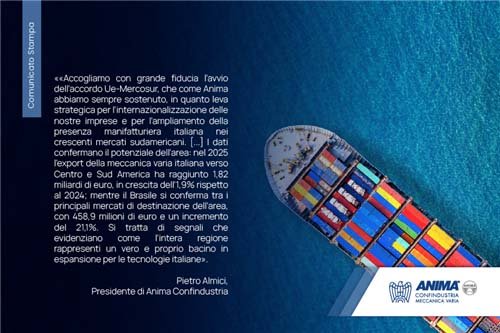
"We welcome with great confidence the launch of the EU-Mercosur agreement, which we at Anima have always supported, as a strategic lever for the internationalization of our companies and for expanding the presence of Italian manufacturing in growing South American markets," declared the president of Anima Confindustria, Pietro Almici.
The data confirms the region's potential: in 2025, exports of Italian mechanical engineering to Central and South America reached €1.82 billion, up 1.9% compared to 2024. Brazil , meanwhile, remains one of the region's main destination markets, with €458.9 million, a 21.1% increase. These signs highlight how the entire region represents a truly expanding pool for Italian technologies.
"In this scenario ," Almici continues, " the agreement helps strengthen a market diversification strategy that we believe is essential to reducing dependencies and consolidating the competitiveness of the European manufacturing system. At the same time, it promotes access to raw materials and the development of integrated industrial supply chains: two key elements for addressing the challenges of the energy and technological transition."
A concrete example of collaboration with the South American market is the recent Memorandum of Understanding signed between Anima and Adimra (Asociación de Industriales Metalúrgicos de la República Argentina), the main Argentine association representing the mechanical and metallurgical industries, aimed at promoting industrial synergies, the exchange of expertise, and the joint development of opportunities within their respective markets.
"The launch of Mercosur marks an important step, but it is essential to maintain this momentum and work towards the full implementation of the agreement," Almici concluded. "In an increasingly competitive global context, agreements of this magnitude represent an essential tool for supporting growth, the need for innovation, and, even more importantly, the international presence of Italian and European industry."
Made in steel 2027 strengthens its international dimension: kallanish and smr partner to bring the g
From market analysis and trade flows to geopolitics and the green transition: the next edition expands the content program and introduces new formats for dialogue and in-depth analysis. Made in Steel 2027 brings a global discussion on the future of the steel industry to Fiera Milano. For the 2027 edition, the event, organized by siderweb in conjunction with Fiera Milano, has chosen to strengthen its international reach with two exclusive partnerships with Kallanish and SMR - Steel & Metals Market Research . The goal is to further expand the event's content offering and bring a global perspective to the program on the markets, commercial dynamics, and transformations reshaping the steel industry. "Made in Steel increasingly aims to be a place where the international steel industry can meet and exchange ideas," says Paolo Morandi, CEO of Made in Steel and siderweb. "The partnership with Kallanish and SMR goes precisely in this direction: bringing international expertise, analysis, and perspectives to Milan, creating opportunities for dialogue that can help operators understand an increasingly interconnected and complex market." "The European steel industry, " he adds, " is undergoing a profound transformation, in which competitiveness, trade, energy, decarbonization, and geopolitics are inseparable issues. Made in Steel aims to be a space where these dimensions can be addressed together, bringing together those who produce, process, and use steel, those who analyze scenarios, and those who define the rules." A new series of sessions dedicated to international markets, organized by Kallanish , will focus on three key areas shaping the steel industry: "Global Steel Market Outlook," "Trade and Competitiveness," and "The Future of Steel Production." Participants can choose to take one, two, or all three modules, which will cover global market developments, the changing trade and regulatory environment, and the future of steel production, from raw materials to artificial intelligence and digitalization. SMR - Steel & Metals Market Research is a market research firm specializing in stainless steel and specialty steels, led by Markus Moll. It will organize a conference dedicated to the global markets for carbon and alloy engineering steels, bearing steels, free-cutting steels, and tool steels. The program will provide insights into the global supply structure, trade flows and market volumes, and end-use demand by segment, including 10-year forecasts. The program will also include a global comparison of production costs and an assessment of geopolitical trends and their impact on the engineering steel industry. The new international partnerships will complement the already extensive Made in Steel conference program, curated by siderweb. Entrepreneurs, managers, experts, and representatives of the main industry associations will be invited to discuss issues affecting the future of Italian and European steel. Speakers will also include representatives of Assofermet, Eurofer, Eurometal, and Federacciai, as well as representatives of Italian and European institutions . New formats for dialogue and in-depth analysis The program's evolution also extends to content production and delivery. Made in Steel 2027 will go beyond the traditional conference format: among the new features, a live video-podcast station will be available, designed as an open space for meeting with industry professionals and as a place for content production during the event. The siderweb editorial team will engage in ongoing dialogue with representatives of the Italian and international steel supply chain, gathering testimonials, analyses, and perspectives directly from those attending Made in Steel. The production of podcasts, already part of siderweb's editorial offering, will also continue, strengthening the connection between the physical experience of the event and the digital enjoyment of its content. One of the new features of 2027 will be the arrival at Fiera Milano of “The Green Steel Challenge” , the podcast produced by the Willy Korf Foundation and Kallanish Commodities, which will make live recordings during the event. A new dimension for Made in Steel Made in Steel 2027 will increasingly be the place where the steel industry looks to the world to understand where it is going and to identify the next direction to follow. The partnerships with Kallanish and SMR are part of the event's broader growth path : the twelfth edition of Made in Steel, scheduled for 11, 12 and 13 May 2027 at Fiera Milano , presents itself with a renewed layout and expanded spaces in pavilions 8, 12 and 16 , designed to welcome an ever-increasing number of companies and promote visibility, networking and business opportunities along the entire steel supply chain. Following the growth of the 2025 edition, which attracted over 19,000 attendees and nearly 400 companies from all over the world, Made in Steel is looking to 2027 with the aim of further consolidating its role as a European platform for discussion, innovation, and development for the sector. Made in Steel is the international conference and exhibition dedicated to the steel industry. It is organized by siderweb - the steel community alongside Fiera Milano. Made in Steel is a conference and exhibition. It offers opportunities for business and reflection, networking and learning. It is both an exhibition showcase and a cultural hub that, with conferences, forums, and roundtables, aims to foster competitive collaboration and the exchange of information, essential elements for business growth. Since 2023, Made in Steel has been certified for sustainable event design and management according to the ISO20121 standard. siderweb - The Steel Community is the only online publication in Italy dedicated entirely to the steel industry. It is a point of reference for industry professionals, thanks to its simple style, focus on in-depth analysis, and objectivity. Since 2009, it has been tracking the prices of raw materials and steel products on the national market every week, now numbering over 60, using a method certified by the Laboratory of Statistics, Data, Methods, and Systems at the University of Brescia. Since 2022, it has published five weekly indices for scrap, carbon steel, long and flat products, and stainless steel. Since 2005, it has organized Made in Steel, the international Conference & Exhibition dedicated to the steel industry, and structured its contents: conferences, interviews, and outlooks.
 Industriale.it certification